It seems to me that some glimpses of beauty call to be seen in defined frames. During the recent long and stunning Autumn, I recorded many such instances during ordinary walks in ordinary settings.
not by a thread
I dangle
by my petiole
not holding on
but letting go
so gradually
toward my only flight
The first time in October that I hiked at my favorite Minnesota lake, the foliage glowed, but the environment had lost its summer song. The bugs were gone, and silence emanated an intense peace. Long amber strands of light flowed through the leaves.
I see the prairie first as I pull in the public parking lot of a lakeside, regional Minnesota park. Every week the colors have changed. Today I don’t even go into the woods because the prairie captures me with her stunning elegance. Today, the prairie looks like a maiden at the height of unselfconscious radiance.
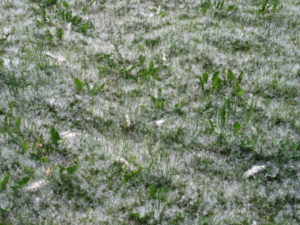
Robins evaded my camera. They chose the quietest spots striped with shade along an asphalt trail to forage. Cottonwood seeds lined the trail and clover continued the white lace pattern in adjacent grass. This looked like the place for a wedding processional.
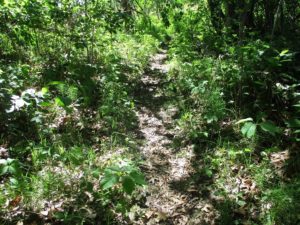
An unofficial path meanders from lakeshore, to hillside, and across a meadow. The smell of humus hangs suspended. The trail keeps drawing my attention downward so as not to stumble among Wild Sarsaparillas and Wood Anemones.
the thrill of the small
path made for one foot and then
just one foot again
The skinny trail I walk enhances my awe of the Mississippi. Water licks the shore three feet to my right. The trail fades to open forest floor. I look up, and am dazzled by the canopy of bright May. Massive slabs of yellow rock lay scattered ahead. I hike over them and pick up the trail again. I’m thinking so many people must have been drawn to this very place over thousands of years.
“Knowing honor, but clinging to disgrace, you become the valley of the world.” – Tao Te Ching, Chapter 28
Food is grown in the valley. Animals find water there and thrive. A town in a valley benefits from the lush environment of the lowlands and the protection of the mountains.
In symbolic language, scaling a mountain can mean achieving a goal, overcoming a problem, becoming someone. This is ego development.
Going downhill, and even being injured or killed, can symbolize ego diminishment.
If understood symbolically, the Taoist quote above expresses a meaning similar to the ninth Beatitude in the Christian Bible:
Blessed are you when people insult you, persecute you and falsely say all kinds of evil against you because of me.” – Matthew 5:11
The interpretation of these images in dreams all depends on a person’s individual growth process. Sometimes development of the ego is the best course. Sometimes sacrifice of the ego opens doors.
The degree to which Western culture overvalues ego development creates confusion for modern people. Carl Jung wrote that ego development is most often a psychological task for the first half of life. Development of relationship with the Self is for the second half of life (Jung, 1933). There are exceptions of course.
Jung characterized the Self as the wise core of each psyche. The Self is the part that knows your greatest potential and guides toward achievement of that (Jung, 1968). When you’re young, it’s important to get a foothold in life. It helps to feel good at something, to achieve things, to be praised and recognized.
But at some point, the ego is strong and you may be able to make the common good a higher priority than ego development. This can involve a radical change in psychological orientation. For instance, if Stephanie trained as a speed skater and won nationals, she would have become very competitive. If she later ran a training school for skaters, she could collaborate more effectively by sacrificing competitiveness. A new form of success would involve cultivating supportiveness for the success of others.
This sounds simple. But sacrificing the winning aces of the past creates inner conflict. The inner champion yells in her mind, “After all we’ve done, you’re going to be a doormat now?!” The expert in her mind shouts, “Don’t listen to them – tell them what you know!” The inner survivor gets anxious, “If you act like this, your business will fall apart. People will think you’re weak.”
A different person could have started life with an idea of collaboration as success and then be called to do the opposite in later years. Development processes are highly individualized.
If we look at the ninth Beatitude as a form of psychological judo, it shows how to change dynamically. It coaches toward the radical shift in orientation: ‘Be prepared for internal resistance against change; endure the voices of resistance and don’t give in to them. This will foster good fortune.’
Works Cited
Jung, C.G. Analytical Psychology: Its Theory and Practice (The Tavistock Lectures). Vintage Books, 1968.
Jung, C.G. Modern Man in Search of a Soul. Harcourt, 1933.
May, Herbert G. & Metzger, Bruce M. (editors). The New Oxford Annotated Bible with the Apocrypha: Revised Standard Version. Oxford University Press, 1977.
“Man is ruled by Earth. Earth is ruled by Heaven. Heaven is ruled by the Way. The Way is ruled by itself.” – Tao Te Ching, Chapter 25
Like ancient Christians, Taoists conceive of heaven as the spiritual realm. Westerners see this dualistically – as an inner reality, and an outer, mundane world. Taoists conceive of the spiritual realm as permeating both inner and outer reality. Carl Jung characterized this sphere as a vast inner wilderness. Yet certain natural laws of the inner realm can be observed and mapped. This was a large part of Jung’s life’s work. The eighth Beatitude expresses a principle of inner natural law from a dualistic perspective:
“Blessed are those who are persecuted because of righteousness, for theirs is the Kingdom of Heaven.” — Matthew 5:10
To consider this statement, I’d like to first attempt a translation of the Taoist quote at the top of the page:
Humans are ruled by their desires and physical needs. Their earthly life is ruled by their own psychology. This includes the reality of larger archetypal forces and laws of spirituality (similar to laws of nature). This is ruled by the Tao, which Carl Jung labeled the Self. The Self in action is ruled by the Self.
The early Christian writings often use parables and metaphor. The Kingdom of Heaven is one of these. Some of the defining statements of it are:
“The kingdom of heaven is like treasure hidden in a field which a man found and covered up; then in his joy he goes and sells all that he has and buys that field.” — Matthew 13:44
“The kingdom of heaven is like a grain of mustard seed which a man took and sowed in his field; it is the smallest of all seeds, but when it has grown it is the greatest of shrubs and becomes a tree, so that the birds of the air come and make nests in its branches.” — Matthew 13:31/Mark 4:30-32/Luke 13:18-19
“The kingdom of heaven is like leaven which a woman took and hid in three measures of flour, till it was all leavened.” — Matthew 13:33/Luke 13:20-21
“The kingdom of God is within you.” — Luke 17:21
To summarize, it’s a state of mind/heart that brings joy, is exceedingly valuable, makes what seems impossible possible (leavening), can start tiny and grow to be a source of shelter and sustenance.
The Beatitude assumes there will be conflict in pursuing righteousness. From a Jungian standpoint, the friction takes place inside. Westerners have sometimes depicted such this as a person with an angel on one shoulder and a devil on the other. A person has both constructive and destructive impulses. The person of integrity finds a way to act on the constructive and not the destructive.
This should be discerned individually. What’s constructive for one person may not be constructive for another. Moral law depends on the inner life of each individual and the actualization of that person’s potential. The compass is “the still small voice” inside each person.
To conclude, I’d like to share two additional Taoist sayings that express the essence of what it means to have “The Kingdom of Heaven,” from a Taoist standpoint:
“Being a model to the world, eternal virtue will never falter in you, and you return to the boundless. – Tao Te Ching, Chapter 28
Ancient masters of excellence had a subtle essence, and a depth too profound to comprehend. – Tao Te Ching, Chapter 15
Works Cited
May, Herbert G. & Metzger, Bruce M. (editors). The New Oxford Annotated Bible with the Apocrypha: Revised Standard Version. Oxford University Press, 1977.
Blessed are the peacemakers, for they will be called children of God. – Matthew 5:9
If offspring are the same species as their parents, then peacemakers are fledgling gods. Since making peace is almost impossible, this makes sense.
Efforts to make peace often produce the opposite result. Someone who sets out to be a peacemaker brews trouble because of the shadow. To identify with anything evokes its opposite. If I say, “I’m a peacemaker,” then I’ve just disowned my primitive shadow. When the shadow is disowned, it functions unchecked in the unconscious mind. It becomes a stealth operative in a situation. The term “passive-aggressive” describes such a pattern with a modern term.
A complex aspect of this problem is that people who value peace don’t want to see themselves as combative. Yet how many peace-oriented groups are peaceful?
One way to actually make peace is to deal with inner conflict. First, assume yourself to have both peaceful and warring motivations. Look searchingly for your love of conflict. Look for hidden motives in providing “help.” Dissect conflicts to identify the feelings within the issue. Own the warrior in yourself. Appreciate the positive side of this archetype.
By doing this first, it’s possible to lay a foundation for identifying negative aggressive impulses in ourselves. This is the key for making peace. Once I’m willing to see a destructive impulse in myself, I have more capacity to make decisions about it. I can contain it, delay it, discuss it, dismiss it, and sometimes even transform it.
May, Herbert G. & Metzger, Bruce M. (editors). The New Oxford Annotated Bible with the Apocrypha: Revised Standard Version. Oxford University Press, 1977.
“Blessed are the pure in heart for they shall see God.” Matthew 5:8
As a Jungian psychotherapist, I work with people to help them understand their dreams. In the Jungian framework, symbols of wholeness in dreams are sometimes understood as “Self” figures. The Self can appear as a mandala in stained glass in the Cathedral De Notre Dame. It can appear as a mandala in the form of a sumptuous pizza with a symmetrical design of toppings. It can appear as a fossil of a fish embedded in stone, as Moby Dick the great white whale, or as a terrifying gigantic catfish. It can appear as a piece of petrified wood. It can appear as a pair of ornately beaded shoes. The images and emotional tone vary greatly depending on the person and circumstances. But in all of these cases the Self appears to the dreamer with a message, an inspiration, or a push toward change. People from all walks of life dream of the Self, whether they believe in the sacred or not.
Jung wrote that dreams are generated by the Self, for the purpose of each person’s self-actualization. He described the Self as a presence of the divine in each human – akin to the Apostle Paul’s concept that each person carries part of the body of Christ. “For just as the body is one and has many members, and all the members of the body, though many, are one body, so it is with Christ.” 1 Corinthians 12:12
Jesus teachings as related by the Christian Bible encourage people to see the difference between a life lived for satisfaction of basic appetites, and a life lived for development of their soul. As related by Matthew:
“Enter by the narrow gate; for the gate is wide and the way is easy, that leads to destruction, and those who enter by it are many. For the gate is narrow and the way is hard, that leads to life, and those who find it are few.” 7:13-14
I feel this passage carries the spirit of the sixth Beatitude. In my experience, the Creator appears often in life and in dreams. But it’s when someone sacrifices an ego-oriented lifestyle, that greater clarity comes. In the midst of this, ecstatic and inspiring surprises support further progress. Further sacrifices lead to keener perception. This vantage point facilitates vision. The increase in sensitivity that also comes with such sacrifices generates greater capacity for both empathy and ecstasy.
The writings of the Taoist Chuang Tzu express similar sensibilities:
From Chapter 32 of his self-titled book on Taoism: “The intelligence of the mean man does not rise beyond bribes and letters of recommendation. His mind is beclouded with trivialities. Yet he would penetrate the mystery of Tao and of creation, and rise to participation in the One. The result is that he is confounded by time and space; and that trammeled by objective existences, that he fails apprehension of that age before anything was. But the perfect man, – he carries his mind back to the period before the beginning. Content to rest in the oblivion of nowhere, passing away like flowing water, he is merged in the clear depths of the infinite.”
From Chapter 26: “Only the perfect man can transcend the limits of the human and yet not withdraw from the world, live in accord with mankind and yet suffer no injury himself. Of the world’s teaching he learns nothing. He has that within which makes him independent of others. If the eye is unobstructed, the result is sight. If the ear is unobstructed, the result is hearing. If the nose is unobstructed, the result is smell. If the mouth is unobstructed, the result is taste. If the mind is unobstructed, the result is wisdom.”
Watson, Burton (translator). Chuang Tzu: Basic Writings. Columbia University Press, 1996.
May, Herbert G. & Metzger, Bruce M. (editors). The New Oxford Annotated Bible with the Apocrypha: Revised Standard Version. Oxford University Press, 1977.